
How we made a viral commercial for developers
Earlier this month we aired “The peaceful way to ship software,” a commercial we filmed with Martin Starr, otherwise known as Bertram Gilfoyle from the HBO show Silicon Valley.
The peaceful way to ship softwareThe spot has 5M+ views on YouTube and 12M+ views on X/Twitter.
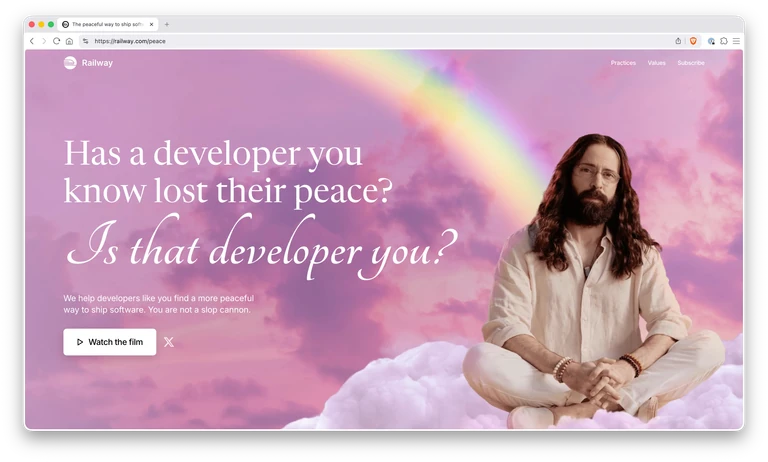
We also produced a microsite …
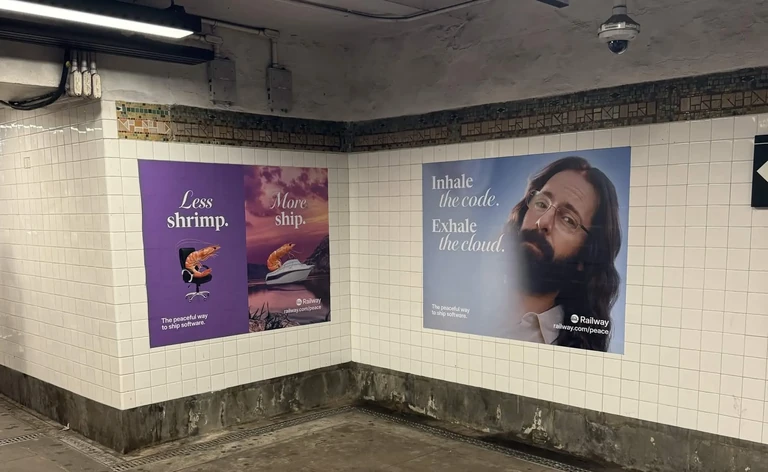
… and put up out-of-home transit ads in the New York MTA ...
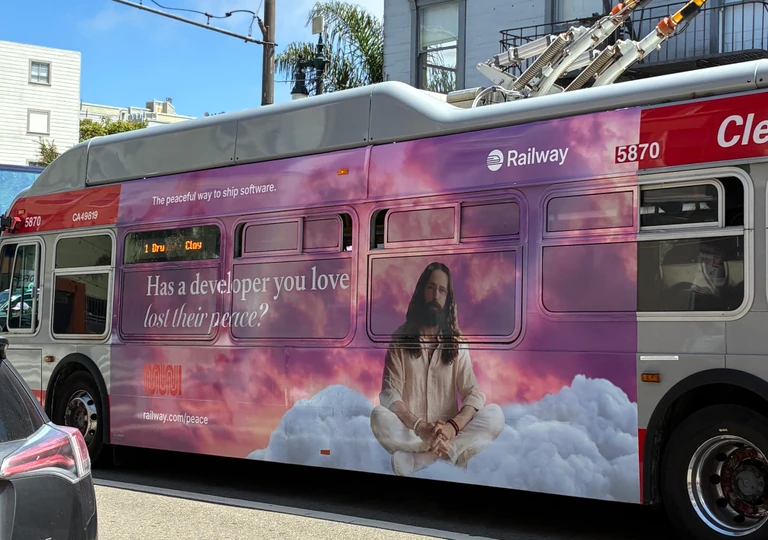
... the San Francisco MUNI ...
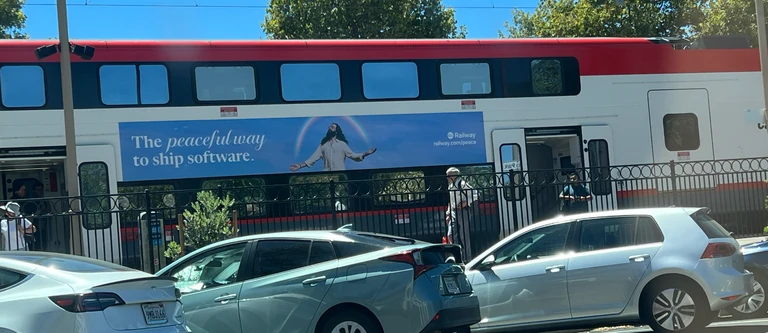
... and the Caltrain that runs from San Francisco south through Silicon Valley ...
We haven’t seen many posts out there about how exactly to do something like this.
So this is the story of how we made a commercial that a developer like you would watch.
Inspiration
We were inspired by a few recent brand spots from Instacart, Anthropic, and Bland.
Bunny Ears by Instacart for the emotional appeal:
Bunny EarsKeep thinking with Claude by Anthropic for the “anthemic film” feeling
Keep Thinking with ClaudeFirst Rapper to Automate His Voice with AI by Bland feat Soulja Boy for the celebrity guest appearance and “stunt” appeal
SouljaBoy AIWe wanted to do something that would feel as "momentous" as any of these spots yet unique to Railway and our current "Ship software peacefully" web motif and campaign.
The all-important brief
The first thing we did was write a creative brief.
Every production studio we approached said that we wrote a phenomenal brief, and it seemed to make a big difference in how they responded to our inquiry.
We included these sections:
- Ask: We requested QTY a 45s hero spot, QTY 1-3 x 10s bumpers, and QTY 3 x 3s teasers
- Budget: We started at ~$300K, but because we secured celebrity talent this figure ballooned substantially
- Timeline: We gave roughly 12 weeks for production through distribution
- Audience: We would target Railway's ~3M developer users as well as audiences on X, YouTube, Reddit, and transit hubs in SF and NYC
- Message: We needed to express our current campaign which depicts Railway as "the peaceful way to ship software"
- Concept starters: We suggested a number of concepts, see below
- Selection criteria: We would evaluate the studio based in descending order of these criteria:
- Creative pitch
- Reel
- Ability to hit deadline
- Price
We then looked at the reels of about QTY 20 different production studios evaluating them for talent and the ability to "understand" a company a message like ours.
We fired off the brief along with a quick email note to the QTY 4 studios we liked best:
Hi,

We're interested in working w/ {Production Studio} to cut one or several ad spots for Railway, which is an internet software company serving developers.

Here is the brief: {link}

We're looking to get started as soon as reasonable.

Look forward to hearing back,

David
We heard back from all four.
From there, we met with each studio and asked them to pitch us on their concepts.
Selecting a production studio
As part of the brief we wrote, we developed QTY 5 concepts in-house, each of which would have made something good.
Those concepts were:
- Nostalgia for the present
- The obsession of the builder
- The creative “payoff”
- The tech industry celebrates the wrong people
- Every revolution has a last mile
Yet for each of these treatments, we were unable to identify “the hook” that would keep people enthralled with the spot.
We kept thinking that’s good, but why would people watch it?
So we listened intently to the pitches from each production studio. Could they build something more captivating than our concepts?
Each production studio partner pitched a number of ideas, and ultimately, after sitting through about QTY 10 different concept pitches, one stood out above all the rest.
That winning pitch was from Revery, a brilliant creative studio based in PDX, LA, and NYC.
The pitch
Revery pitched us on bringing a surprise celebrity into a zen garden to promote the "peaceful" motif of the campaign.
They proposed securing Martin Starr for the role and we immediately loved the concept of bringing everybody's favorite character from Silicon Valley into the fold in the guise of a "wise developer guru."

It was a spectacular premise. We were hooked.
Could we secure the celebrity talent and make the commercial in time for our deadline?
That's when Revery really started to shine. They systematically kept us on track from storyboarding through final delivery of film and out of home advertising assets without ever missing a beat.
Here's what that looked like.
Timeline
- Mar 5 - Sent briefs out to QTY 4 different studios. Intro call with each
- Mar 17 - Awarded concept #4 to Revery, contingent on celebrity talent
- Mar 20 - SOW signed ("Railway Brand Anthem")
- Apr–May 4 - Negotiated and closed Martin Starr
- May - Pre-production: location, casting, wardrobe, script sessions, OOH design rounds
- Jun 2 - One-day shoot in Malibu
- Jun 10–26 - Post-production: two edit reviews, picture lock, color, sound, cutdowns; OOH files delivered
- Jun 26 - Final delivery
- Jun 29 - Launch: site live, all OOH live in real life
Shooting the spot
It might surprise you that most of the work happens before the shoot itself.
We went through round after round after round of script review, as well as location, casting, wardrobe, and creative review.
Revery had us approve every single detail, from the casting decisions of who will play the background developers, to the wardrobe decisions, to everything in between..
By the time we got to shooting day, we'd all been through the script and creative decisions dozens of times.
That's when the fun started and our commercial started coming to life.


Conclusion
Making this campaign come to life was a blast.
Here are some things we learned:
- The highest costs are celebrity talent and shooting in a place like Los Angeles (we did both)
- Most of the work is in the writing, so keep writing until it’s good
- Some studios “don’t pitch” because they win business on reputation alone … don’t work with them unless you really know exactly what you want and think they can deliver it
- The logistics engine of the studio is as important as the creative, so pay close attention to the ability of the operators at the studio
- Negotiating with talent is not easy! There’s a lot that the right talent partner can help smooth over
- Be clear about the rights you want upfront (US vs global, out of home media vs digital, etc)
And most importantly, have fun.
Thanks for reading, and remember: You are not a slop cannon!

